The photographs of this coast are nearly always taken from a car window on a bright day, looking north along a curve of road with basalt above and sea below. What they leave out is that the road is the easy part. The nine glens run inland from it, steep and wooded and full of falling water, and almost everything worth walking to is up one of them, away from the view that sold you the ticket.
The second thing people get wrong is scale. Nine glens sounds like a region. It is a strip of coast roughly 25 miles long from Larne to Ballycastle, and you can drive its whole length in an hour and a quarter without hurrying. The distances that matter here are vertical. Glenariff climbs about 1,000 feet from the shore to the head of the glen in under three miles of walking, and the path does it in a series of stairs and switchbacks beside water. That is why a seven mile day here costs more than a ten mile day on flat ground.
The third is the weather, and here the correction runs the other way. This coast is milder than its latitude suggests, which surprises people who look at a map and see it sitting level with Hudson Bay. What it is instead is wet, in small amounts, very often. That is a different problem and it needs different boots.
- The week in one sentence
- Nine nights split between two family-run guesthouses, five in a Glenariff village and four near Cushendall, with a local driver moving suitcases between them on the changeover morning and returning walkers from the far end of each day's route.
- Why this and not the next one
- Belfast International is 38 miles from the first bed, about an hour and ten minutes by road. The ground is wet almost every day: peat on the tops, boardwalk and steel stair in the ravines, wrack and rounded basalt cobble at the shore. Beds are ordinary guesthouse rooms with private bathrooms, no elevator, breakfast cooked to order. The season runs late March to late October. Nine nights, from $2,960 per person, two sharing.
- Inside the figure
- Nine nights in two guesthouses with private bathrooms; cooked breakfast each morning; suitcase transfer on the changeover day; eleven guided walking days with a local guide; road pickup at the end of each walk; the Glenariff forest park entry fees; two packed lunches on the long coastal days; a rented waterproof jacket and overtrousers in your size if you would rather not carry your own; the written route notes and 1:25,000 mapping for every day.
- Outside it, and what that runs to
- Flights, which have run $780 to $1,340 round trip from the middle of the country depending on month; airport transfers, about $95 each way by car or $13 by scheduled bus to Ballymena and a second leg; seven dinners, which run $22 to $38 a head in the village bars; all drinks; the ferry day to Rathlin at $22 return per person plus the minibus; laundry, which one guesthouse charges $14 a load and the other does not offer; travel insurance, which this office does not sell or advise on; anything you break.
- Reasons to book something else
- Do not reserve this if you cannot walk seven miles on wet ground with 1,400 feet of climb, on eleven days out of nine nights, with two of those days at ten miles and 2,100 feet. Three ravine paths are steel stair bolted to rock with a handrail on one side and a drop on the other; there is no alternative route on those days and no way to take a wheelchair or a stroller onto them. Boardwalk gets slick. Two guesthouses have stairs and no elevator. If wet feet for nine days sounds like a ruined week, this is the wrong week.
What the water has done to this hillside, and what that costs your knees
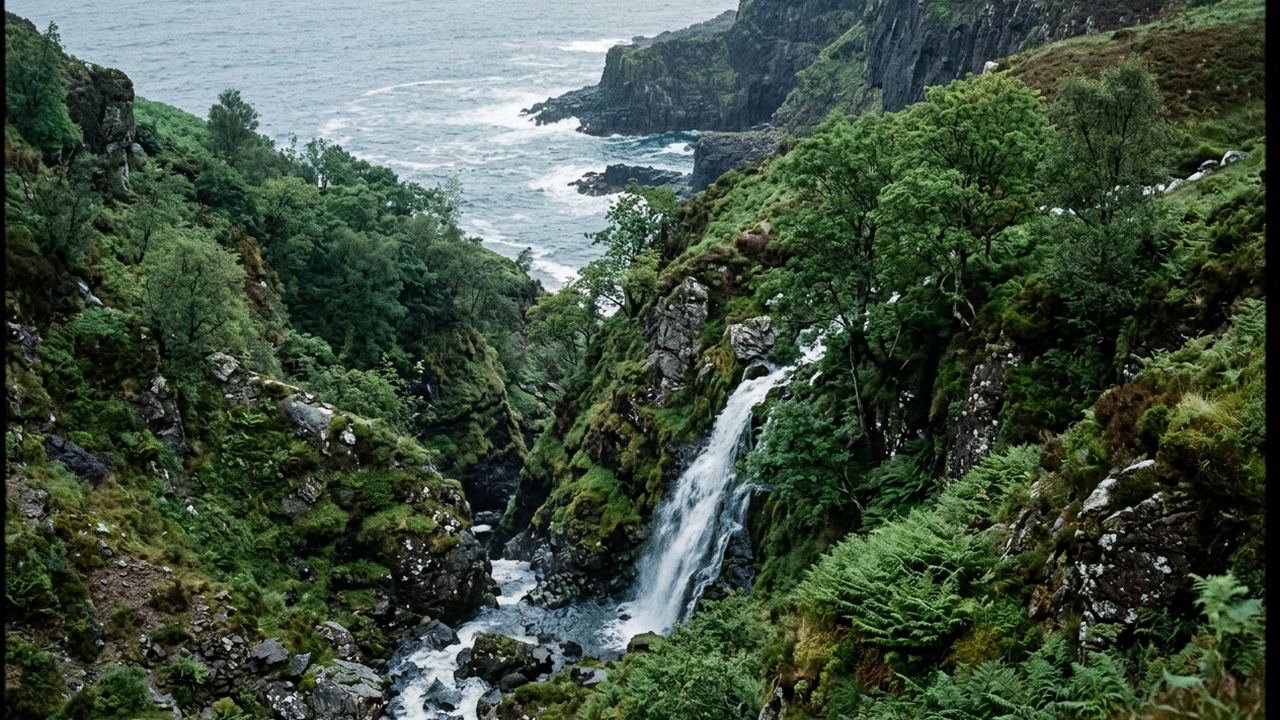
The Antrim plateau is basalt laid down in sheets, sitting on softer chalk and clay. Water gets into the joints, works down to the softer rock underneath, and the whole edge fails in slow landslips. That is the mechanism that made the glens and it is also why the coast road, built between 1832 and 1842, had to be cut at the foot of the cliff rather than run along the top: the top keeps moving. Sections of it have been rebuilt after slips within living memory.
For a walker the consequence is that almost every path splits into two kinds of ground. The valley floors are wooded, sheltered and stepped, with hazel and ash and a lot of moss, and in the ravines the trail becomes engineered: timber boardwalk, steel stair, a handrail bolted into wet rock. Above the treeline it turns to open peat and rough pasture with a barbed wire fence and a stile every half mile. You will do both in the same day, most days, and your feet will be wet by the second hour whatever you paid for the boots.
On the record rather than the forecast: the years we have booked here, late spring has been the driest stretch, with several May weeks running six dry days out of seven and afternoon temperatures in the high fifties. July and August have been warmer by only a few degrees and noticeably wetter, with rain most days in some amount. What the season does not usually deliver on this coast is cold. Hard frost at sea level is rare and snow on the plateau seldom lies more than a day or two. The complaint we get is never that it was freezing. It is that it never entirely stopped drizzling.
The kind of walker this week is actually built around
This suits someone who is content to walk seven miles in a light rain, eat a packed lunch standing under a tree, and be picked up at four o'clock by a driver who has been doing this route for eleven years. It suits people who like a place better once they understand how it was made. It does not suit anyone who needs a view they can count on for a particular day, because on a low grey day you will see the inside of a wooded glen and nothing at all of Scotland.
On the clear days you do see Scotland. The Mull of Kintyre sits about 16 miles across the North Channel from Torr Head, and on a good afternoon you can pick out individual white buildings on it and watch the ferries working the crossing between Ballycastle and Kintyre. That is a real thing that happens here and it is also entirely out of anyone's control. We do not build a day around it.
The same twenty-four trips are printed in five orders. This one sits in a different place in each, and none of the five positions is a judgement about it.
- Hours in the air
- 7 of 24 at 11 hours. The whole order
- Miles walked a day
- 13 of 24 at 7 miles. The whole order
- Per cent decided in advance
- 24 of 24 at 80 per cent. The whole order
- From, per person
- 20 of 24 at $2,960. The whole order
- Different beds
- 2 of 24 at 2 beds. The whole order
Nine seasons of records from this stretch of coast
- Late March to mid April
- Paths at their wettest and the ravines running hard, which is when the waterfalls are worth the trip. Some upper stiles still churned to mud. Beds at the season's opening figure, about $2,960.
- Mid April to late May
- The steadiest stretch on the record: longest dry runs, bluebells through the glen woodland in early May, temperatures in the mid to high fifties. Booked out first, and the figure rises to about $3,180.
- June
- Light until nearly eleven at night, which changes what a walking day can be. Midges start on still evenings in the sheltered glens. Around $3,240.
- July and August
- Warmest, wettest, busiest. The coast road carries tour coaches and the Glenariff car park fills by ten. Ferry crossings to Rathlin sell out days ahead. Peak figure, about $3,420.
- Early September to mid October
- Our own preference. Coaches thin out from the first week, the light goes long and low across the basalt, and heather on the plateau is still colored into late September. Back to about $3,040.
- Mid to late October
- Genuinely short days, walking finished by half past five, and the first real gales come through. Two of the eleven walking days get shortened most years. Lowest figure of the season, about $2,960.
- November to mid March
- We do not run this week. Guesthouses close, the upper paths are unsafe in the dark, and there is no honest way to sell eleven walking days out of a nine hour day.
The bit nobody mentions until the second evening
The awkward thing about this week is transport, and it is awkward in a way that money does not entirely fix. There is no rail line along this coast and the scheduled buses run to serve schools and shops, not walkers, which means the timetable that gets you to a trailhead at half past nine on a Tuesday does not exist on a Saturday. The whole week is therefore built around one local driver and one vehicle. If that driver is ill, and it has happened, the day gets rearranged around a route we can reach on foot from the guesthouse door rather than cancelled. It is an honest fix and it is still not the day you were expecting.
The expensive thing is Rathlin. The island sits six miles offshore, the crossing takes 25 to 45 minutes depending on the boat, and it is the best single day of the trip on a settled morning. It is also the day most likely to be lost: sailings are cancelled in a swell, sometimes with an hour's notice on the pier, and in July and August the boats fill with day visitors well before we could reserve for a group. We have priced it as an extra at $22 return rather than folding it into the figure, because pretending we can guarantee a sea crossing on a fixed date would be a lie and you would be paying for it either way.