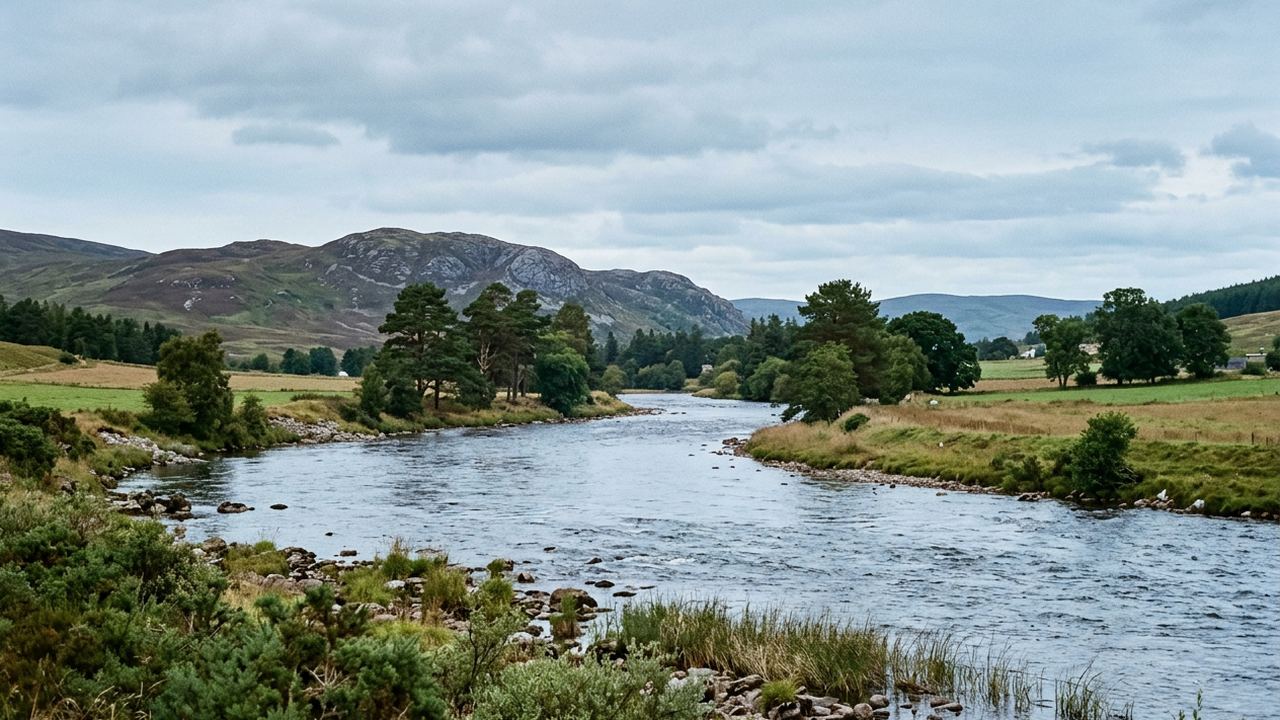
The photographs of this river are almost always taken from a bridge at Craigellachie or from the lawn of a distillery, and both angles make the Spey look ornamental. On the ground it is a working river in a working valley. It drains a very large piece of the Highlands and it moves fast, wide and shallow over gray gravel, loud enough at Aberlour that you hear it from the road. In spate after two days of rain it turns the color of milky tea and shifts gravel audibly. Nobody swims in it. The fishing beats along it are private, they are let by the week for real money, and a walker sees the fishing as men standing thigh deep at eight in the morning and still standing there at four.
The second thing the photographs leave out is that most of the walking is on a railway. The line from Craigellachie up to Boat of Garten closed in the late sixties and the bed of it is now the path. That is why this trip walks eight miles a day and climbs almost nothing: a railway engineer would not accept the gradients that a hill path takes for granted. It also means long straight stretches between cuttings where you see the same view for forty minutes, and it means the surface is crushed stone rather than earth. Some people find that dull by day three. Others find that after a year of standing up at work, a level surface and a straight line is exactly the thing.
Whisky is unavoidably the local industry and there are more working distilleries within ten miles of Aberlour than anywhere else in the country. We include one tour because leaving it out would be strange. But this is not a distillery week. Four of the eight days you are walking beside water, and the buildings you pass most often are farm sheds, a salmon hatchery, two closed stations and a great many pines.
- The week in one sentence
- Eight nights: four in a small hotel at Aberlour, two in a guesthouse at Grantown on Spey, two in an inn at Kingussie, with a driver moving the party and the bags between the three by road while you walk the section in between.
- Why this and not the next one
- Inverness airport is thirty five miles from Aberlour, an hour by road, and there is no closer field. The ground is the old Speyside Way and the rail bed it sits on: crushed stone, near level, some farm track and one pine section that holds water. Beds are three separate small properties, not one base. The season runs late March to late October; the middle houses close from November. Eight nights, from $2,950 per person, two sharing.
- Inside the figure
- Eight nights of rooms with private bath in three properties, two people sharing; breakfast every morning; the road transfers between the three bases; bag movement on the four walking days; airport pickup at Inverness and the return; one distillery tour on the Aberlour section, booked by us, ticket in your name; a printed set of the day routes with the wet sections marked; the request handling, the calls to the properties and the written figure before you commit.
- Outside it, and what that runs to
- Flights from the United States, usually $780 to $1,340 round trip to Inverness by way of a European hub; lunches and dinners, running $22 to $60 a head in this stretch of Moray; any drink; a second distillery tour, $18 to $95 depending on how old the bottle is at the end; the Strathspey steam line if you want to ride it, about $22; taxis on the two days the party splits and half of you walk while half do not; single occupancy, which adds $640 across eight nights; any question of border paperwork or medical cover, neither of which this desk does sell or advise on.
- Reasons to book something else
- Do not reserve this if eight miles on foot, four days out of eight, on stone and farm track, is more than your knees will take: the longest day is eleven miles from Cromdale into Grantown with almost no climb but no shelter either, and there is no shorter version of it that still reaches the bed. It suits nobody who needs a lift waiting at a fixed hour, since the road rarely runs beside the river. Anyone hoping for mountain days will be looking at the Cairngorms from twelve miles off all week and never standing on them.
What the river does to the ground you walk on
The valley floor here is farmland: barley, cattle, some late silage cut in August. Above it on both sides the ground goes to pine, birch and scrub, and above that to heather. The path uses all three at different points but stays low, generally within eighty feet of the water. Between Ballindalloch and Cromdale it runs through a stretch of old pine woodland that never dries out properly. That section holds water through the whole season, not just in spring, and it is the one place on the route where boots matter more than comfort.
The temperature record for Moray is milder than the latitude suggests, because the coast is close and the Gulf air comes in over it. Through June, July and August the days have generally sat between 58 and 68 degrees, with a run of days above 72 most summers and rarely more than a week of them. Nights in the shoulder months have often dropped to the high thirties. Rain is the honest problem: this is not a dry corner of Scotland, and in the years we have been sending people here it has rained on some part of roughly half the walking days. It is usually rain that stops rather than rain that settles in.
A day has a plain shape. Breakfast between seven thirty and nine, bags out by nine thirty, then four to six hours on the path with a stop somewhere it makes sense to stop. You are generally into the next village between two and four in the afternoon. Nothing is scheduled after that. Two of the eight days have nothing on them at all, and people spend them differently: some walk anyway, some sit by the water, some take the road to Elgin and look at the ruined cathedral.
Who tends to come back from this one satisfied
This suits a walker who is content covering ground rather than gaining height, and who does not need a summit at the end of the day to feel the day counted. It suits people who like knowing where they will sleep. It suits a pair who can walk at slightly different speeds without it becoming a discussion, because the path is wide, straight and impossible to lose, and one of you can be twenty minutes ahead for an hour without anyone worrying.
It suits people who want a little structure and not much. Fifty five percent of the waking hours here are settled before you land: the beds, the transfers, the bag movement and one tour. The rest is yours and there is nothing in the folder telling you what to do with it. If that reads as thin, this is not the week.
The same twenty-four trips are printed in five orders. This one sits in a different place in each, and none of the five positions is a judgement about it.
- Hours in the air
- 10 of 24 at 11 hours. The whole order
- Miles walked a day
- 20 of 24 at 8 miles. The whole order
- Per cent decided in advance
- 20 of 24 at 55 per cent. The whole order
- From, per person
- 19 of 24 at $2,950. The whole order
- Different beds
- 7 of 24 at 3 beds. The whole order
What the season has actually been like here
- Late March to mid April
- Path open, most properties open, and the valley still brown. Cold: many mornings under 40 degrees. Rivers high with snowmelt off the Cairngorms, and the wet pine section near Cromdale is at its worst. Rooms at the low end of the range.
- Late April to end of May
- The best stretch on the record for walking. Birch comes into leaf, the light runs to nine at night by late May, and the biting insects have not started. Dry spells are common. Rooms fill early because of it, so this window wants four months of notice.
- June
- Long light, up to about eighteen hours of it. Warm enough for shirtsleeves most afternoons. Midges begin in the still, damp sections and around the pine, generally from the second week. They are a nuisance at dusk, not on the move.
- July and August
- Busiest, warmest, and the two months when the local events fill every bed in Aberlour and Grantown on the same weekend. Add roughly $180 per person for rooms. Midges are at their heaviest in the woodland stretch. Barley cut toward the end.
- September
- Widely the second best window. Insects gone after the first cold night, the light still good until eight, and the hills behind turn as the heather goes over. Rain has been more frequent than in May but the path drains.
- October
- Quieter, colder, and the color is worth the coat. Dark by six thirty at the end of the month. Two of the three properties reduce their kitchen hours, so dinner takes planning. Rooms at the low end again.
- November to mid March
- The middle base closes and the route is not sold. We will not build a version of this week around it.
The distillery question, and why we book only one
People assume a Speyside week means a distillery every day, and it is possible to arrange that. We do not, for two practical reasons. The first is that the tours run to fixed times, most of them between ten and three, and every one you add takes a bite out of the middle of a walking day. Two in one day means either a short walk or a taxi. The second is cost: the standard hour long tour runs about $18 to $25, but the tastings people actually want, the ones that open older bottles, run to $95 and are limited to a handful of seats. Adding four of those quietly puts $300 a head on the week, and it belongs in your decision rather than in ours.
The other awkward thing is the road. The A95 runs the length of this valley and the path crosses or shadows it more than once. There is a section south of Ballindalloch where you walk perhaps two hundred yards from traffic for the better part of a mile, and it is noisy. We would rather say so than have you find it on the second morning. It is one mile out of about thirty two, and the rest of the route is genuinely quiet, but a mile of road noise annoys some people out of all proportion and they should know it is there.