The photographs of this range almost always show one of four glacial lakes, taken from the shore in still weather, with a wall of dark spruce behind it and nobody in the frame. That is an honest picture of about forty minutes of the trip. It leaves out the other side of the same watershed, where roughly a third of the spruce is standing dead, silver, barkless, killed by beetle in waves since the late 1990s and left where it fell because most of the core is a no intervention zone. People arrive expecting a cathedral of old trees and walk half a day through what looks like a shipwreck. Then in the fourth or fifth year of that ground, the light reaches the floor for the first time in a century and the regrowth comes up so thick you cannot see your boots. Both things are the same forest.
The second thing the photographs leave out is that this is one of the emptiest inhabited landscapes in Europe, and it is empty on purpose. From 1948 the western third of these hills sat inside a restricted border strip. German speaking villages were cleared after the war, then whole Czech settlements were pulled down through the 1950s so that nothing would stand within sight of the wire. You will walk past mown clearings with a stone doorstep in the grass, a lilac gone wild, an orchard in rows with no house. There are around a hundred and fifty of these. The park now marks some of them with a low post and the name. Nobody rebuilt, because for forty years nobody was allowed to, and after 1990 there was no one left who wanted to.
What that leaves you with is unusual and worth being clear about: a rounded, second growth, damaged, recovering forest with more red deer and lynx than people in it, a road network built for soldiers, and a lot of ground where the last permanent resident left before your parents were born.
- The week in one sentence
- Nine nights in four places: three in a Vimperk guesthouse, two in a converted forestry lodge at Modrava, two above Cerne Lake, two in Ceske Budejovice; a driver moves the bags between the four, and you walk or take the summer forest bus.
- Why this and not the next one
- Nearest practical airport is Prague, then two and a half hours south by road, or Munich at three hours from the western trailheads. The ground is granite and gneiss worn round, nothing above 4,900 feet, with peat basins between the ridges crossed on plank boardwalk. Beds are family guesthouses and one forestry lodge, private bath, no elevators. The season runs mid May to mid October; the high bog trails open in stages as nesting closes. From $2,790 per person, two sharing.
- Inside the figure
- Nine nights in double rooms with private bath; breakfast every morning and six dinners; all bag transfers between the four bases; a licensed local guide on five walking days; national park entry and the summer forest bus pass; a printed route book with grid references and bailout points; the return road transfer between Prague airport and Vimperk; and a written figure priced against your dates before anything is confirmed.
- Outside it, and what that runs to
- International airfare, which has run $760 to $1,320 round trip from Chicago or Dallas depending on month; three dinners, budgeted at $18 to $30 each; all lunches, since half the walks have no building on them and you carry food from the guesthouse; the Czech tourist board accommodation levy of roughly $2.20 per person per night, collected in cash at each guesthouse; boat rental on Lipno at about $16 an hour; laundry, which one guesthouse charges $9 a load and the others do not offer; and any bicycle hire, at $14 to $22 a day.
- Reasons to book something else
- Do not reserve this if nine miles a day on wet plank and loose granite is beyond you. Five of the nine days run seven to eleven miles with 1,200 to 2,100 feet of climb, and the boardwalks through the bogs are one plank wide, unrailed, slick after rain, and set two to three feet above standing water. There is no vehicle access to the middle of the walking days: the shortest bailout on the Modrava sections is four miles. Anyone who needs a bathroom within an hour, or who cannot get up from a fall unaided, will have a bad week here.
The bogs are the whole reason the walking is slow
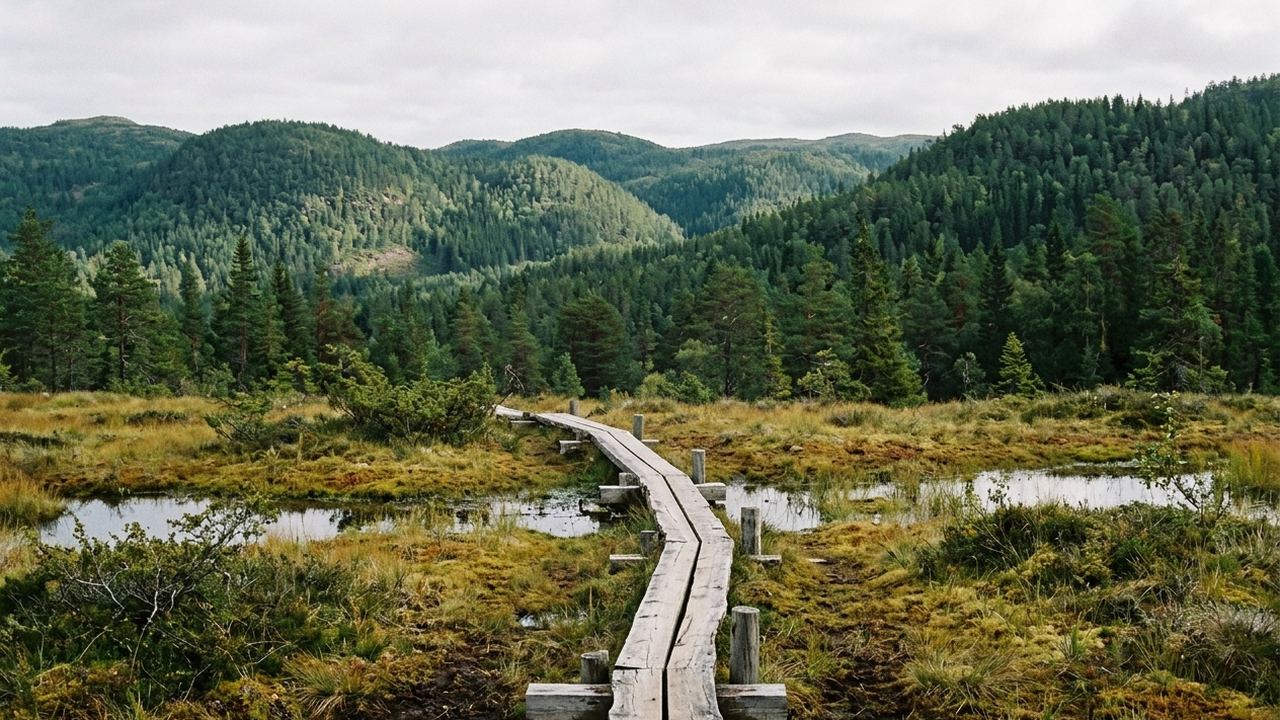
The high plateau between Modrava and Bucina holds raised peat bogs, some of them thirty feet deep and eight thousand years old. They are why the trails here are plank rather than dirt. You are not walking on the bog; you are walking above it on boardwalk laid to keep boots out of the surface, and the surface is a living thing that grows about a millimeter a year. Off the plank the ground will take a leg to the knee, and in a few basins considerably further. The plank is one board wide in places, wet with dew until mid morning, and there is no rail. This is where the nine mile average stops being an easy number.
The record of the season, rather than any forecast: May runs cold and long here, with frost on the plateau into the first week of June most years and the highest bog trails still shut for nesting. Daytime highs in June have generally sat in the mid sixties, July and August in the low to mid seventies, with the plateau ten degrees cooler than the valley towns and afternoon thunderstorms in roughly one afternoon in three. September has been the driest stretch of recent seasons and the most reliable for long days. Rain is not seasonal so much as constant in small amounts: this is one of the wetter corners of the country, which is exactly why the peat is there.
The shape of a walking day is four to seven hours moving, one long stop, and no shops. Two of the days start with a forest bus because private cars are excluded from the middle of the park in summer, which is the single best thing anyone has done for this landscape and also the reason your day begins at a timetable rather than at your convenience.
Who tends to get on with nine days of this
This suits people who are content to walk a long way through a landscape that is not putting on a show, and who find the emptiness interesting rather than oppressive. Several guests each season say the deadwood sections were the part they thought about afterward. It also suits people who want a European walking week without alpine exposure: nothing on this route involves a chain, a ladder, or a drop, and the highest ground you stand on is Plechy at about 4,480 feet, which is a walk up, not a climb.
It does not suit anyone who wants a village with a bar at the end of every day. Four of the nine evenings are in places with one building serving food, and it stops serving at eight.
The same twenty-four trips are printed in five orders. This one sits in a different place in each, and none of the five positions is a judgement about it.
- Hours in the air
- 11 of 24 at 11 hours. The whole order
- Miles walked a day
- 23 of 24 at 9 miles. The whole order
- Per cent decided in advance
- 15 of 24 at 50 per cent. The whole order
- From, per person
- 15 of 24 at $2,790. The whole order
- Different beds
- 18 of 24 at 4 beds. The whole order
What each stretch of the season has actually been like
- Mid May to early June
- Bogs still closed above 3,600 feet for grouse and capercaillie nesting; larch and beech just leafing; frost on the plateau most nights; two of the nine walks substituted lower down. Quietest trails of the year.
- Mid June into July
- Everything open, and light in the sky until half past nine, the plateau at its greenest, and the heaviest thunderstorm frequency of the season. Mosquitoes over the peat basins are genuinely bad; bring repellent, none is sold in the park.
- Late July to mid August
- Warmest stretch, low to mid seventies in the valleys, and the only period when the lakes and Modrava get crowded on weekends. Weekday walking is still solitary. Rooms are tightest and cost most here.
- Late August to mid September
- The steadiest walking of the year on the record: dry ground, stable afternoons, bilberries on the open slopes, and the deer rut beginning toward the end. This is the stretch we get asked for and cannot always fill.
- Late September to mid October
- Beech turns copper against the dead spruce, mornings run into the thirties, and the forest bus drops to a weekend timetable, which reshapes two of the days. Last dinners served in some lodges around the tenth.
- After mid October
- We stop running this. Guesthouses close, the buses stop, dark falls at half past four, and the plateau trails become an unpleasant slog rather than a walk.
The dead spruce and the money question nobody asks first
Some people reserve this and then arrive angry about the beetle killed stands, so it is worth putting the number down in advance: expect roughly a third of your walking hours in view of standing dead trees, and on the Modrava plateau sections closer to two thirds. The park's policy in the core zones is to leave them. That decision is contested inside Czechia and you will meet people locally with strong opinions in both directions. We do not have one, and the guides have been asked to explain the argument rather than settle it.
The awkward money point is the bag transfer. Four bases in nine nights means the driver crosses the park three times, and the roads that would make that quick are exactly the ones closed to traffic. Two of the transfers take an hour and forty minutes to cover twenty two miles. That cost sits inside your figure, and it is a real part of why this week prices where it does rather than lower. If you would rather carry your own pack and skip the driver, say so on the form and we will price it that way; it comes down by roughly $210 a person and it makes the boardwalk days harder than they sound.