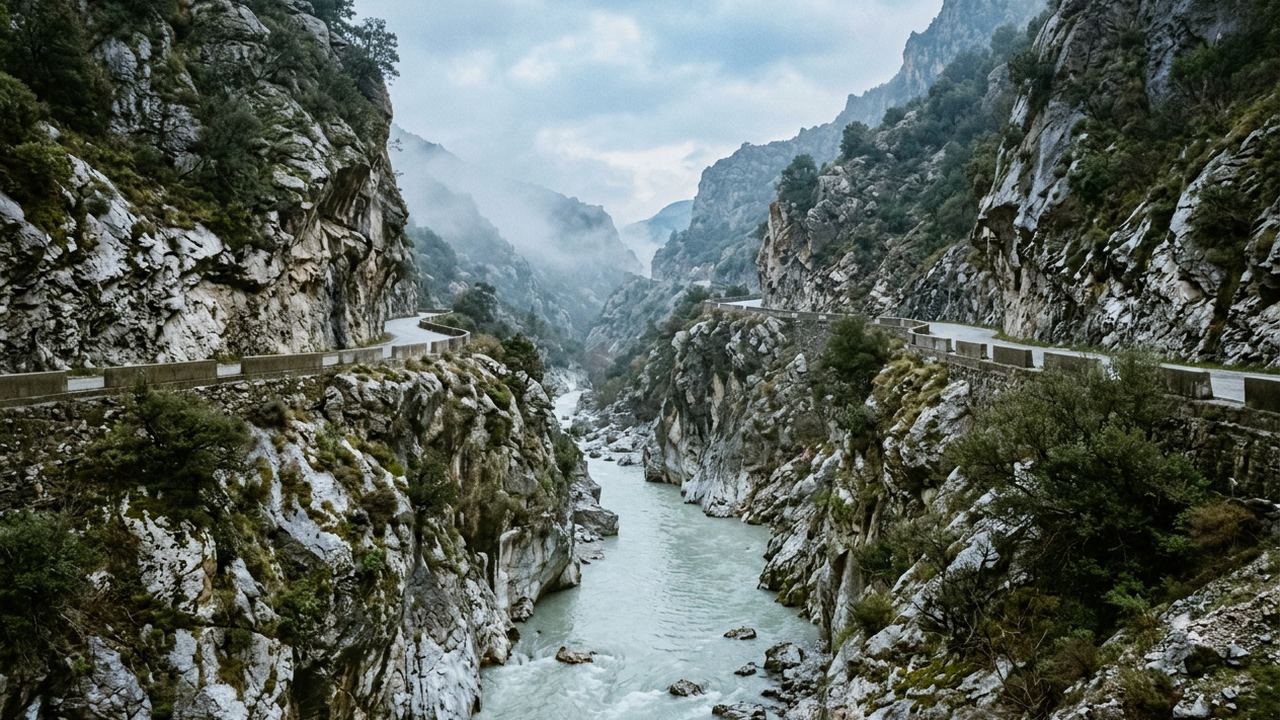
The photographs of Taroko are almost always taken from one of four places, all of them within a few steps of a parking area, all of them looking up. What they leave out is the noise. The Liwu river runs fast through a slot it has been cutting for millions of years, and inside the narrow sections you cannot hold a conversation without raising your voice. They also leave out the trucks. This is Highway 8, a real road with real freight on it, cut into marble by hand and by men who died doing it, and it is barely wide enough for two vehicles in several places. Walking the old highway sections means standing aside for buses.
The second thing people get wrong is scale. The gorge is not a day. The road from the arch at the mouth to Tianxiang is about twelve miles, and beyond Tianxiang it climbs for another forty toward the mountain pass at nearly 11,000 feet. Most visitors see the twelve miles in five hours from a bus window and count the place as done. This week gives the gorge three walking days, then leaves it, because the coast and the rift valley behind it are the reason anyone lives here and the gorge is only the part that photographs well.
The third thing is that the mountain moves. A magnitude 7.4 earthquake in April 2024 killed people inside the park and shut the gorge almost entirely; sections reopened slowly through 2025 and 2026 and some remain closed with no reopening date. Typhoons bring down more rock every autumn. Any operator who tells you in January exactly what you will walk in March is guessing. This office does not do that. It tells you what was open last week and rebuilds the days when it is not.
- The week in one sentence
- Nine nights: four in a small hotel in Xincheng near the gorge mouth, two in a homestay in the rift valley near Yuli, three in a guesthouse on the coast south of Hualien city, moved between by hired car with a driver, and luggage travels in the car rather than on your back.
- Why this and not the next one
- Hualien airport takes almost nothing international, so the practical arrival is Taipei Taoyuan and then a rail transfer of two and a half to three hours down the coast. The ground is marble and schist, hard and steep, cut by a road with unlit tunnels. Beds are small family hotels and homestays, twin rooms, tiled floors, no elevators in the rift valley house. The season runs mid October to early May. Nine nights, from $2,690 per person.
- Inside the figure
- Nine nights in twin rooms with private bathrooms; breakfast every morning; hired car with a driver for six of the nine days; rail seats from Taipei to Hualien and back; a licensed local walking guide for three days in the gorge; national park entry and shuttle fares inside the gorge; one indigenous kitchen dinner in a Truku village; one dinner and one lunch in the rift valley; drinking water and helmets for the tunnel sections; all lodging taxes and service charges.
- Outside it, and what that runs to
- International flights, which have run $1,050 to $1,700 round trip from Chicago or Dallas in the shoulder months; the Taipei nights at either end if you want them, about $95 to $180 a night; most lunches and all dinners not listed above, figure $9 to $25 a head; the Qingshui cliff boat, $30 per person; the Hualien to Taitung branch fare if you add the southern day, about $12; laundry, about $6 a load; tips for the driver and guide, customarily $10 to $20 a day each; anything at all on a day the gorge road closes and the itinerary is rebuilt around it.
- Reasons to book something else
- Do not reserve this if six miles a day on stone steps and steel ladders is beyond you. The Zhuilu Old Road is three and a half miles out and back with 1,200 feet of climb and a half mile stretch of cut ledge three feet wide with a 1,500 foot drop and a cable to hold. The tunnels are unlit and the rock overhead is loose enough that helmets are required, not suggested. Rift valley lodging has no elevator and beds are on the second floor. If heights or unlit enclosed spaces frighten you, the gorge is most of this trip and there is not much left without it.
What the rock is doing while you walk on it
The gorge is marble, metamorphosed limestone, and the Liwu cuts down through it faster than almost any river anywhere because the whole island is being pushed up at roughly three quarters of an inch a year where the Philippine Sea plate meets the Eurasian. That uplift is why the walls are 3,000 feet of polished grey and white with a river at the bottom you can throw a stone across. It is also why rock falls. The park issues helmets at the trailheads for the tunnel walks and the requirement is not decorative.
A day here has a shape set by the light and by the road. You leave Xincheng around seven thirty because the tour buses from Taipei arrive between ten and eleven and the narrow sections become a queue. Walking is done by early afternoon. The heat in the gorge itself is moderate because the walls hold shade, but on the coast and in the rift valley the record for October through April is daytime highs of 72 to 82 degrees, dropping to the low sixties overnight in January and February at rift valley elevations. Humidity stays high all year and nothing dries overnight.
The rain record is the thing to plan around. The east coast catches the northeast monsoon from roughly late October to March, which produces grey drizzle rather than downpours, and the mountains behind produce their own weather regardless. From June to October the record is typhoons: not every week and not every year, but Hualien county has taken direct hits often enough that this trip is not offered between mid May and mid October at all. That is a record of what has happened, not a claim about what will.
Who walks this well and who finds it a long way to go
This suits somebody who wants one intense landscape rather than a circuit of towns, who is content to eat what a homestay kitchen makes rather than choose from a menu, and who reads a closed trail as information rather than a failure of arrangements. Roughly half the waking hours here are decided in advance, which in practice means the driver, the guide days, the beds and three meals are fixed and the rest of every afternoon is yours in a place where the bus timetable is the main constraint.
It does not suit anybody on a tight schedule. The flying time is nineteen hours from the middle of the country before the rail leg, and the gorge is a further two and a half hours from the airport you land at. If you are considering this as part of a wider Asia trip, say so when you write, because the routing changes what the rail seats should be.
The same twenty-four trips are printed in five orders. This one sits in a different place in each, and none of the five positions is a judgement about it.
- Hours in the air
- 24 of 24 at 19 hours. The whole order
- Miles walked a day
- 12 of 24 at 6 miles. The whole order
- Per cent decided in advance
- 16 of 24 at 50 per cent. The whole order
- From, per person
- 13 of 24 at $2,690. The whole order
- Different beds
- 9 of 24 at 3 beds. The whole order
What each stretch of the open season has actually been like
- Mid October to mid November
- The typhoon window has usually closed by the third week of October, though not always. Warm, 78 to 84 degrees, water still swimmable off the coast. Trails often still have storm damage under repair.
- Late November to mid December
- The quietest stretch. Grey mornings on the coast, clear inland by noon more often than not. Highs 72 to 78. Homestay rates fall and the rift valley kitchens have time to talk to you.
- Late December to early January
- Cool and wet on the coast, 62 to 72, with drizzle that can sit for three days. The gorge itself stays walkable because the walls shelter it. Book rooms early around New Year.
- Mid January to late February
- Coldest, 58 to 70 in the rift valley, occasional snow on the high pass which closes the road above Tianxiang. Cherry blossom in the villages in mid February. Fewest people all year.
- March
- Warming, 68 to 78, and the most reliable stretch for clear cliff views along the Qingshui section. Rain returns in the second half of the month more often than not.
- April
- Warm and increasingly humid, 75 to 84. Green rice in the rift valley, which is the best it looks all year. Domestic holiday traffic around the tomb sweeping holiday fills the gorge road.
- Early May
- The last workable stretch. Hot, 82 to 88, heavy afternoon cloud building over the mountains. After the second week the trip closes until October.
The road closes and there is no way around that
Here is the awkward part stated plainly. There is one road through the gorge. When a section shuts, there is no parallel route, no detour, no alternative canyon an hour away. In 2024 and into 2026 several of the best walks, including stretches of the Shakadang and the Baiyang trails and the Zhuilu Old Road permit itself, were closed for long periods and reopened piecemeal. If the Zhuilu permit is not being issued in your week, the single most dramatic walk of the trip does not happen, and no amount of arranging changes that.
What this office does instead is check the park authority's posted trail status the week you travel and again the day before each walking day, and build the days from what is actually open: the coastal cliff road at Qingshui, the Dali Datong villages above the gorge mouth, the rift valley cycle paths near Yuli, the Walami trail on the far side. That is a good week. It is not the week in the photographs, and if the photographs are the reason you are going, this is the wrong month or possibly the wrong trip. Nobody will offer you a refund for a closed trail because nobody sold you one; the figure covers beds, transport, guiding and the listed meals, and it covers them whether the mountain cooperates or not. This office takes no payment from you at any point. The operating company bills you directly and pays this office a commission afterward.