The photographs are always taken in the two hours after rain, when the moss is lit and the air is full of steam, and they leave out the other twenty-two. Yakushima gets between 160 and 400 inches of rain a year depending on where you stand on it, and the old island saying is that it rains thirty-five days a month. That is not a joke about the weather. It is a description of the operating conditions. Every part of this trip is designed around being wet by ten in the morning and dry again by six at night, and the single largest cause of a bad week here is arriving with clothing that only works in a shower.
The second thing people get wrong is the scale. From a map it looks like a small round island you could see in two days, and it is only twenty-eight miles across, but the middle of it goes up over 6,300 feet at Miyanoura-dake, which is the highest point in southern Japan outside of the Ryukyus. The road runs around the edge. There is essentially no road into the interior. Everything worth seeing in the middle is reached on foot, up, and back down the same way, and the driving distances around the ring road are slow: forty miles of coast road with one lane through the villages takes two hours.
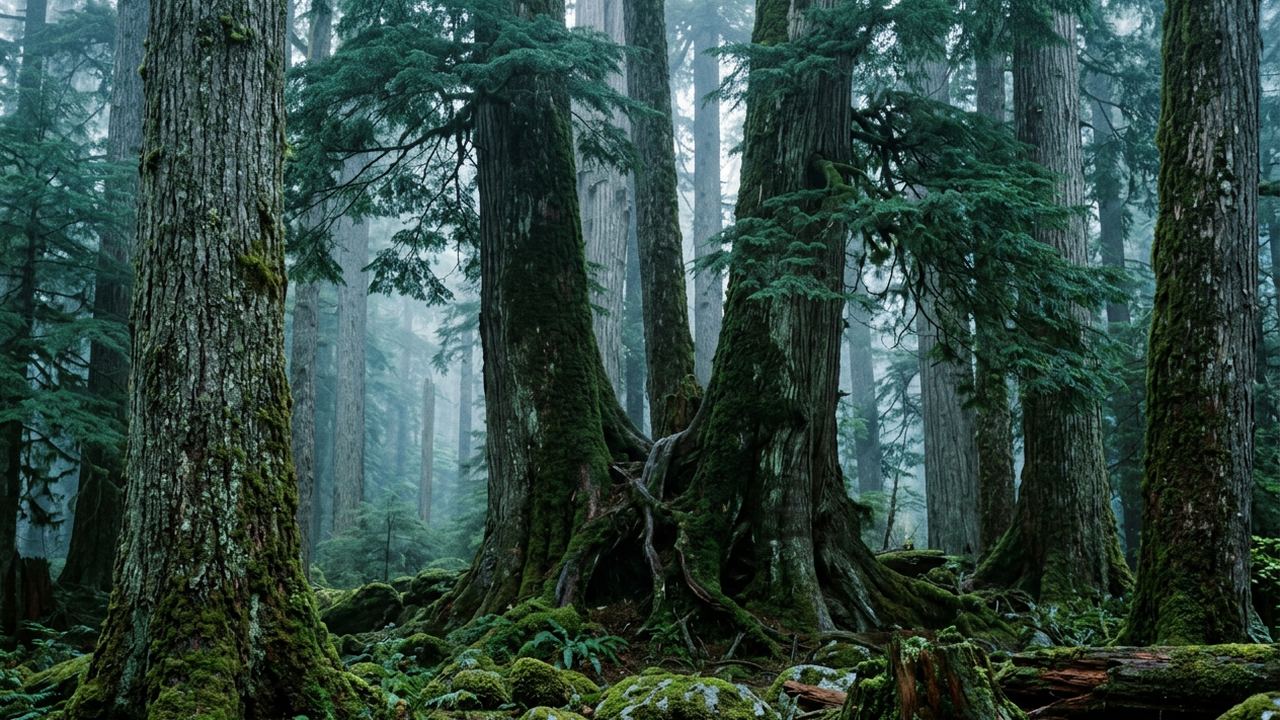
The third is the cedars themselves. A yakusugi is a cedar over a thousand years old, and the reason they got that old is that the granite gives them almost no soil, so they grew slowly, dense with resin, and were not worth the effort of felling in the Edo period when the straight-grained ones were cut for shingles. What survived is knotted, hollow, twisted and enormous. They do not photograph as tall. They photograph as wide and strange, and standing under one is a matter of proportion rather than height.
- The week in one sentence
- Nine nights in three places: four in a small inn at Miyanoura on the north coast, three in a family guesthouse at Anbo, two at Onoaida in the south, moved by rented car, with the two large bags staying in the car and a daypack carried on the trails.
- Why this and not the next one
- Yakushima sits sixty miles south of Kagoshima, which is a ninety minute flight from Tokyo or a four hour ferry from the mainland port. The ground is granite, so the trails drain and then flood, and the roots are polished slick. Beds are inns and guesthouses with tatami and futon, not hotels. The island is walkable all year, but we place trips between late March and early December, and skip the two typhoon-heaviest weeks. From $3,620 per person.
- Inside the figure
- Nine nights in three lodgings with breakfast; the return ferry or flight between Kagoshima and the island; nine days of a small rented car with insurance and the island fuel allowance; the Yakusugi Land and Shiratani Unsuikyo conservation fees; the shuttle bus permit and seat for the Arakawa trailhead on the day you walk to the old cedar; a licensed island guide for the two mountain days; six dinners at the inns; a written route sheet with bail-out points and bus times for every walking day.
- Outside it, and what that runs to
- International and domestic airfare, usually $1,150 to $1,700 round trip from a middle-of-the-country hub; three dinners on your own nights, about $18 to $35 each; lunches, which on trail days means convenience store rice balls at about $6; the $220 to $340 of extra nights if a typhoon closes the ferry and the airport together; rain gear, which must be a real hardshell and not a poncho, rented on the island at $28 a day if you arrive without one; boot rental at $12 a day; onsen entry at $2 to $6; travel insurance, which this office does not sell or advise on.
- Reasons to book something else
- Do not reserve this if you will not walk seven miles in rain that does not stop. The day to the oldest cedar is ten miles round trip with 2,700 feet of climb, most of it on wet roots and railway sleepers, and it takes nine to eleven hours. The mountain day is 3,900 feet of climb on granite steps. There is no way to see the interior from a car. If you need dry weather to enjoy a week, or cannot manage stairs and roots for a full day, this island will be nine nights of frustration.
What the granite does to a walking day
The rock is the whole story. Granite does not hold water, so rain runs straight off it into the streams, and the streams go from ankle deep to impassable in about forty minutes. Every route sheet in this trip lists the two or three stream crossings that close first and the point at which you turn around instead of continuing. Guides on this island turn parties around often, and the ones who do not are the reason the rescue helicopter flies.
The same rock is why the walking is harder than the mileage suggests. There is very little dirt underfoot. There are polished roots, wet stone slabs, and long stretches of decking and old logging railway sleepers laid across bog and ravine. The sleepers are the fastest walking on the island in dry conditions and the most treacherous in rain, because the wood is coated in a film of algae. Poles help. Boots with a soft sticky sole help more than a stiff mountaineering sole. On the Arakawa route to the oldest cedar you will spend roughly five miles on that railway before you reach the forest path at all.
On the record of the last several decades, the wettest stretch of the year has been the plum rain in June, when the interior can take twenty inches in a week, and the driest has been the second half of October and November, when a run of four consecutive dry days is common rather than lucky. That is a record and not a forecast, and it does not predict your particular week. What it does is tell you which weeks are worth paying more for and which weeks come with a real chance of losing two days.
Who walks out of here glad they came
This suits people who are content with one big thing per day and nothing else. A typical day is: leave the inn at five in the morning, walk for nine hours, get back, sit in a hot spring, eat a set dinner of flying fish and mountain vegetables at six thirty, and be asleep by nine. There are no evenings on Yakushima in any urban sense. Miyanoura has a supermarket and two bars. Anbo has less. If that sounds thin, it is thin, deliberately, and the people who love this island are the ones who wanted it thin.
It also suits people travelling as a pair or alone who do not mind sharing a trail. The oldest cedar route carries several hundred people on a good day in the high season, on a single track, and the shuttle bus that reaches the trailhead is a permit system precisely because of that. Solitude on this island is a function of which trail you pick and what hour you leave, not of the island being empty.
The same twenty-four trips are printed in five orders. This one sits in a different place in each, and none of the five positions is a judgement about it.
- Hours in the air
- 23 of 24 at 16 hours. The whole order
- Miles walked a day
- 15 of 24 at 7 miles. The whole order
- Per cent decided in advance
- 3 of 24 at 30 per cent. The whole order
- From, per person
- 23 of 24 at $3,620. The whole order
- Different beds
- 10 of 24 at 3 beds. The whole order
Nine years of the island's own record, month by stretch
- Late March to late April
- Cold in the interior, 38F at the high camp and snow still lying above 5,000 feet in some years. Coast is mild and green. Ferries reliable. The lowest stretch on the operator's own scale, and the least crowded.
- Golden Week, roughly April 29 to May 5
- Avoid. Japanese domestic holiday. Inns double, the shuttle permit sells out weeks ahead, and the trail to the old cedar has run over a thousand people in a day. We do not place trips in this window.
- Mid May to late June
- The plum rain. The moss is at its absolute best and the forest is doing the thing it is famous for. Also the wettest stretch on record, and two washed-out days in nine is normal. Adds nothing to the price.
- July and August
- Hot and humid at sea level, 88F and sticky, pleasant at altitude. Sea turtle nesting has run from May into August on Nagata Inaka beach, watched under a warden system at strict distance. Typhoon risk begins in earnest.
- September to mid October
- Peak typhoon record. Two or three storms in a season have closed both the ferry and the airport for two to three days at a time. Cheap, empty, and the stretch where the extra-nights line in the price sheet actually gets used.
- Late October to end of November
- The steadiest walking on record. Cool, 60F on the coast, runs of dry days, colour in the maples above 3,000 feet. The most expensive stretch and the one most people should take.
- December to mid March
- Interior is genuinely wintry with ice on the granite steps, and the high routes need spikes and a guide who will refuse them. Coast is walkable and quiet. We place a small number of low-route trips here only.
The typhoon clause, and why the price sheet has a line for it
Somewhere between June and October, a storm will close the sea and the sky at the same time. The ferry stops before the airport does, and the airport reopens before the ferry, but there is a window of two or three days when nothing moves off Yakushima at all. This happens most years. It is not a rare event to be waved away in a paragraph about how unlikely it is, and any office telling you otherwise on a September trip is being careless with your time.
What this means practically: the extra nights are yours to pay for, at $220 to $340 for the pair depending on where you are stuck, and the missed onward flight is between you and the airline, since the fare rules are theirs and not ours. We will call the inn and hold the room while you are still on the island, because that is a phone call somebody has to make and it is easier from the office than from a guesthouse landline in the rain. We build a spare day into every trip placed after mid August for exactly this reason, which is part of why nine nights and not seven. If the storm does not come, the spare day is a beach day at Isso or a second run at the moss forest, and nobody has ever complained about that outcome.